- Aug 20
How to actually ask for referrals (without hoping people just think of it)
A couple of people asked me some version of the same question last week: how do you actually ask for referrals directly, instead of just hoping happy clients think of it themselves?
Good question! And the honest answer is – just *hoping* doesn't work. I learned that the hard way after years of delivering great work, getting great feedback, and then just... waiting. As if referrals were something that happened to you instead of something you actually go get.
So here's what I actually do now.
Testimonial first, referral later
Right after wrapping a project, while everything's still fresh and they're happy with the result, I ask for a testimonial (note – not a referral yet!!). That's the moment they're most likely to say yes and actually write something good, because the work is right there in front of them and they remember exactly why they liked working together.
I also have the question about referrals in my testimonial form, but it's optional to fill, so I don't push hard on this. Grab my testimonial template form here for free →
The referral ask comes later. A couple of months after the project wraps, I reach out again – reference the project, ask how things are going, and ask if they know anyone who might need something similar.
Why the gap? Because asking for both at once feels like a lot, and because a few months later gives them time to actually think of someone, not just react in the moment.
I track all of this in a CRM I built in Notion, which reminds me when it's time to follow up. Without it, this would fall through the cracks constantly – life gets busy, projects pile up, and "I'll reach out in two months" becomes "wait, that was eight months ago."

What the email I send says
Here's the structure, so you can build your own version:
Reference the specific project – show you remember and it mattered
Be direct about the ask – you're looking for referrals, not hinting at it
Make it easy for them – no pressure, just an open door
Leave the door open both ways – mention you'd also love to hear if anything's come up for them
Simple, direct, and no over-explaining! The goal is to make the ask clear enough that they actually know what you want.
The exact email template is a part of the Client Process Kit I put together, which includes a whole pack of email templates for moments exactly like this one. See details here →
Here's one of the examples from my practice:
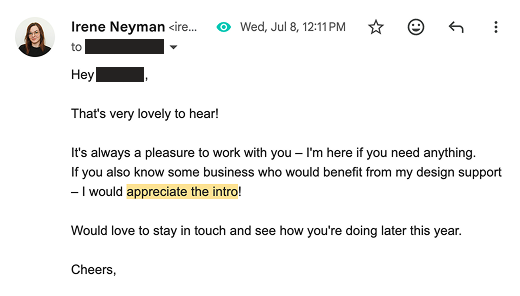
And here's the reply:
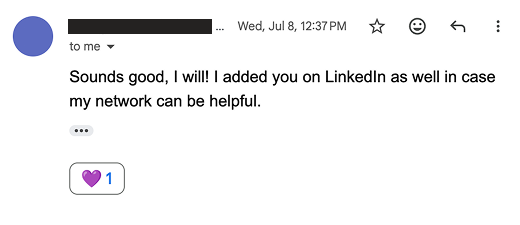
And notice what happened here – they didn't have a referral ready to go. But they added me on LinkedIn "in case their network can be helpful." That's still a win! You planted something. They're thinking about you now in a context where they weren't before, and that alone increases the chances something comes from it later, even if it's not today.
Not every ask leads to an immediate yes. But it almost always leads to being remembered.
Email, but I always leave the door open for more
Usually this happens over email. But I always add that I'd be glad to catch up over a coffee call or in person if they're local – just reconnecting without an agenda!
And that small addition changed more than I expected…
What happened when I actually did this
Recently I reached out to a past client just to catch up. We met up, talked about life and work, and by the end of it she had two direct projects for me and mentioned a creative/art direction opportunity too. I hadn't asked for any of it. I just showed up and stayed in touch.
That's the part people miss about referrals: sometimes the ask isn't even the thing that works. Just staying visible and human to people you've worked with does more than any perfectly worded email.
Why this felt so uncomfortable at first
I used to work at a small event company, and that job had me talking to people constantly – vendors, clients, partners, always some kind of networking happening naturally as part of the day. I got used to it without even realizing.
Then I left and went fully freelance, and somewhere in that transition I basically closed off. Stopped reaching out and stopped keeping in touch. Told myself the work would speak for itself, which – it doesn't, not on its own.
It's been a slow process of opening back up. Reaching out to old clients and old freelancer connections, actually following up instead of letting relationships go quiet. And if I'm being honest, there's also this quiet worry in the back of my mind about my English not being perfect – which doesn't help when you're trying to sound confident reaching out to people. But every time I do it anyway, I'm reminded – networking is the thing that quietly holds all of this together. Not only referrals, but opportunities, collaborations, even friendships in this industry.
A big part of what makes that networking actually work is how you communicate – something I go deep into inside Good Work Isn't Enough Course, which just went up to $59. If you're a newsletter subscriber, I'm giving you 20% off with code THECOURSE for the next 3 days. Details are here →
When I use this method
Not every client gets the referral ask. I use it specifically when the project felt good – when I genuinely enjoyed working with them – and when I know they're the type of person with connections in the industries I want to work in.
And because I know myself well enough to know I'll forget, I set a reminder for a couple of months out right after a project wraps.
If you've been avoiding asking for referrals because it feels awkward – I get it, really! It felt that way to me too. But it gets easier every time you do it, and the people who say “yes” are usually more willing than you expect. Most happy clients want to help. They just need to be asked.
Have you tried asking directly? How did it go? Curious to hear your experience in the comments.
Thank you for reading,